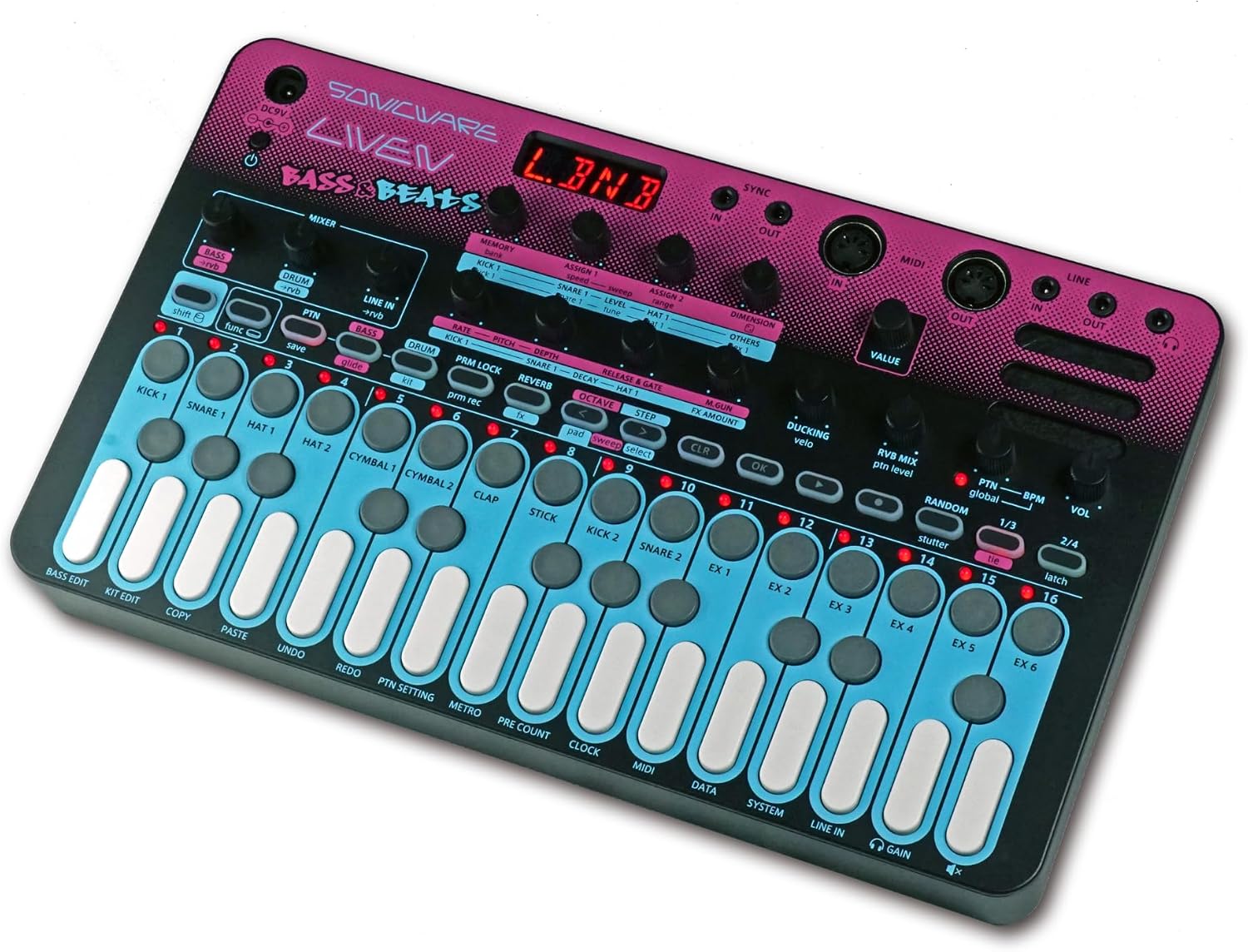
If you’ve been browsing affordable hardware for making beats and electronic music, you’ve probably landed on the name Sonicware. They’re a Japanese company making a line of compact, battery-powered devices called groove boxes — all-in-one instruments that combine sound generation, a built-in sequencer (a step-by-step pattern programmer that tells notes when to play), and effects into one unit you can hold in both hands. The Liven series is their flagship range, and each model targets a different sonic universe: one does FM synthesis, one does lo-fi video game sounds, one leans into bass-heavy dance music, and one covers organic acoustic textures. At prices ranging roughly from $149 to $249 (street prices as of mid-2026), they occupy a genuinely interesting gap between the toy-adjacent Teenage Engineering Pocket Operator ($99) and the more fully-featured Roland TR-8S ($499). This guide maps each Liven model to specific genres and workflows so you can skip the forum rabbit holes and make a decision.
The Liven Lineup at a Glance
Before comparing models, it helps to understand what all four share. Every Liven device runs on AA batteries or USB power, outputs stereo audio via a 3.5mm jack, has MIDI in/out over USB and a 3.5mm TRS connector (a physical socket that carries MIDI data), and uses a 16-step sequencer that can be chained for longer patterns. They all have real-time parameter locking — the ability to record knob movements into the sequence — which Attack Magazine’s budget groove box workflow roundup identifies as one of the key reasons the Liven series punches above its price class in live-use scenarios.
The four current models are: Liven XFM, Liven 8bit Warps, Liven Bass & Beats, and Liven Organ & Orchestra. Here’s a fast numeric anchor:
| Model | Synthesis Type | Voices | Approx. Street Price (USD, 2026) |
|---|---|---|---|
| XFM | 4-operator FM | 8 tones | ~$199 |
| 8bit Warps | Wavetable / bit-crush | 8 tones | ~$179 |
| Bass & Beats | Analog-modeled drums + bass | 8 parts | ~$199 |
| Organ & Orchestra | Additive / sample playback | 8 tones | ~$249 |
These are single-instrument devices, not full drum machines in the Roland or Elektron sense — they lean melodic and rhythmic but don’t replace a dedicated percussion synthesizer for someone building a full live rig. Keep that framing close as you read.
Liven XFM: The One for Techno, Electro, and Sound Design Explorers
FM synthesis — short for Frequency Modulation synthesis — works by having one audio oscillator modulate the frequency of another, producing complex, often metallic or glassy timbres. It’s the engine behind classic Roland and Yamaha sounds from the 1980s: DX7 electric pianos, punchy bass stabs, and the harsh digital textures that define electro and certain strains of techno.
The XFM is a four-operator FM engine, which means it has four of these interlocking oscillators arranged in configurable routing schemes called algorithms. Sound On Sound’s review of the XFM notes that the interface is unusually approachable for FM — a synthesis method that famously intimidates beginners — because Sonicware abstracted the modulation ratios and feedback controls into a set of macro knobs that remain musically useful without requiring you to understand the underlying math. Owners across aggregated forum discussions consistently describe the XFM as their go-to for metallic percussion hits, acid basslines, and clangorous melodic sequences.
Best fit genres: Techno, electro, acid, industrial, IDM (Intelligent Dance Music — a catch-all for experimental electronic music in the tradition of Aphex Twin or Autechre).
Workflow fit: If you’re building a chain around a sequencer hub like the Elektron Digitakt and need a compact FM voice module you can trigger over MIDI, the XFM slots in neatly. Its sequencer is also capable enough to run standalone for sketching. CDM’s hardware coverage of the Liven series flags the XFM’s arpeggiator and chord mode as genuinely useful for live performance — you can lock a chord shape and sequence arpeggios in real time without menu-diving.
Tradeoff to name explicitly: The XFM has no dedicated drum voice architecture. If you want boom-bap or house kicks, you’re coaxing them from FM operators, which takes patience. For pure groove-box drum programming, look at Bass & Beats instead.
Liven 8bit Warps: The One for Lo-Fi, Chiptune, and Bedroom Pop
The 8bit Warps runs wavetable synthesis — a method where audio is stored as short digital waveforms that loop and interpolate — but adds heavy bit-crushing and sample-rate reduction effects that deliberately degrade the audio to sound like vintage 8-bit video game hardware. MusicRadar’s review of the 8bit Warps describes the effect section as unusually deep for the price, with dedicated controls for bit depth (how many gradations of volume the audio uses — lower means crunchier) and sample rate reduction that go well beyond simple “lo-fi” presets.
Owners consistently report that the 8bit Warps rewards experimentation: routing its wavetable tones through the degradation effects at moderate settings produces sounds that sit naturally in lo-fi hip-hop and bedroom pop contexts, while pushing the bit-crush to extremes yields the harsh, aliased textures that define chiptune and classic video-game music.
Best fit genres: Lo-fi hip-hop, chiptune, vaporwave, bedroom pop, experimental electronic.
Workflow fit: The 8bit Warps pairs well with sample-based setups. If your core workflow is a DAW (Digital Audio Workstation — software like Ableton Live or Logic Pro) plus a sampler, the 8bit Warps contributes textural and melodic elements that are genuinely difficult to replicate in software without dedicated bit-crush plugins that cost more than the hardware itself. Perfect Circuit’s editorial notes on the device describe it as a “deliberate aesthetic tool” rather than a general-purpose synth, which is an accurate characterization.
Tradeoff to name explicitly: The wavetable engine is not deep in the modular or patch-programmable sense. You’re choosing from a fixed set of waveform tables and shaping them with macros. If you want the full Serum-style wavetable sculpting experience in hardware, this is not it — but that’s also not the point. The point is the lo-fi aesthetic pipeline, and there it delivers with efficiency that intermediate producers describe as “immediately inspiring rather than immediately frustrating.”
Liven Bass & Beats: The One for House, Techno, and Dance Music Production
This is the most drum-machine-adjacent model in the lineup. The Bass & Beats combines analog-modeled percussion synthesis — digital models of the circuits inside vintage analog drum machines, aiming to recreate the weight and character of those sounds — with a dedicated monophonic bass synthesizer voice, all driven by the same 16-step sequencer.
Synthtopia’s coverage of the Bass & Beats announcement highlighted the dedicated bass voice as the standout differentiator: unlike the other Liven models, which are primarily melodic, the Bass & Beats is built explicitly around the kick-snare-hat-bass relationship that defines most dance music. The drum voices cover kick, snare, hi-hat (open and closed), and percussion, and the bass voice has a filter with resonance — a control that narrows the frequency range and adds a characteristic emphasis at the cutoff point, producing the squelchy quality associated with acid basslines and deep house.
Best fit genres: House, techno, drum and bass, electro, any four-on-the-floor dance music context.
Workflow fit: If you’re a producer who currently does drum programming in a DAW with plugins but wants to move patterns out of the screen and onto physical hardware — a common transitional moment for intermediate producers — the Bass & Beats is a plausible first hardware drum machine that doesn’t require a $499 commitment. Attack Magazine’s roundup notes that the Bass & Beats’s limitation (only one bass voice, no polyphony) is also a discipline tool: it forces arrangement decisions that many producers otherwise defer indefinitely.
Tradeoff to name explicitly: The analog modeling in the Bass & Beats is competent, not class-leading. Owners who have also used the Roland TR-8S or Arturia DrumBrute Impact consistently describe those machines as having more weight and character in the low end. The Liven Bass & Beats is a strong entry-level choice; it is not the machine for someone whose kick drum sound is a primary sonic identity.
Liven Organ & Orchestra: The One for Film Composers, Jazz-Adjacent Electronic, and Textural Work
The newest and most expensive model in the lineup uses a combination of additive synthesis (building sounds by stacking simple sine waves at different frequencies and volumes, the mathematical basis of organ sounds) and sample playback to cover orchestral and acoustic timbres: strings, brass, woodwinds, and organ tones. CDM’s coverage describes it as Sonicware’s bid for the film-music and cinematic electronic market — a smaller niche than dance music but one with real purchasing intent.
Owners working in ambient, neo-classical electronic, and lo-fi jazz contexts describe the Organ & Orchestra as filling a gap in compact hardware: getting usable string and brass pads from a battery-powered device without a laptop. The additive organ section in particular draws favorable comparisons to the Teenage Engineering OP-1’s organ tones, though with more tactile real-time control.
Best fit genres: Ambient, neo-classical, cinematic, lo-fi jazz, experimental.
Workflow fit: Works well as a MIDI-driven voice module in a film-scoring DAW template or as a standalone sketching device for composers who work away from the studio. Less immediately useful for club-oriented production.
Tradeoff to name explicitly: At ~$249, the Organ & Orchestra costs more than the others and serves a narrower use case. The sample-based orchestral elements are not Spitfire Audio quality — they’re stylized and lo-fi by nature. If photorealistic orchestration is your goal, this is not the tool. If evocative, slightly degraded acoustic texture is the aesthetic, it earns its price.
The Decision Rule
Run this if/then before you buy:
- If your core genre is techno, electro, or acid → Liven XFM. The FM engine is purpose-built for those timbres, and no other model in the line comes close.
- If lo-fi aesthetics, chiptune, or bedroom pop are your primary context → Liven 8bit Warps. The bit-crush pipeline is the product; everything else is supporting cast.
- If you make house, techno, or dance music and want hardware drum programming under $200 → Liven Bass & Beats. Accept its limitations on kick weight and use it as a gateway into hardware workflow.
- If you compose ambient, cinematic, or jazz-adjacent electronic music → Liven Organ & Orchestra. It’s the most niche choice and the most expensive; only buy it if those genres are your primary output, not an occasional detour.
- If you’re genuinely unsure → Bass & Beats. It’s the most genre-agnostic starting point in the lineup and covers the kick/bass relationship that most producers need first.
No Liven model replaces a mid-tier dedicated drum synthesizer for a producer who’s ready to invest $300–$500 in percussion hardware. What they offer is a focused, affordable, battery-powered entry into hardware-first workflow — and for producers at the crossroads of software-only and hardware-hybrid production, that’s a legitimate and well-priced proposition.