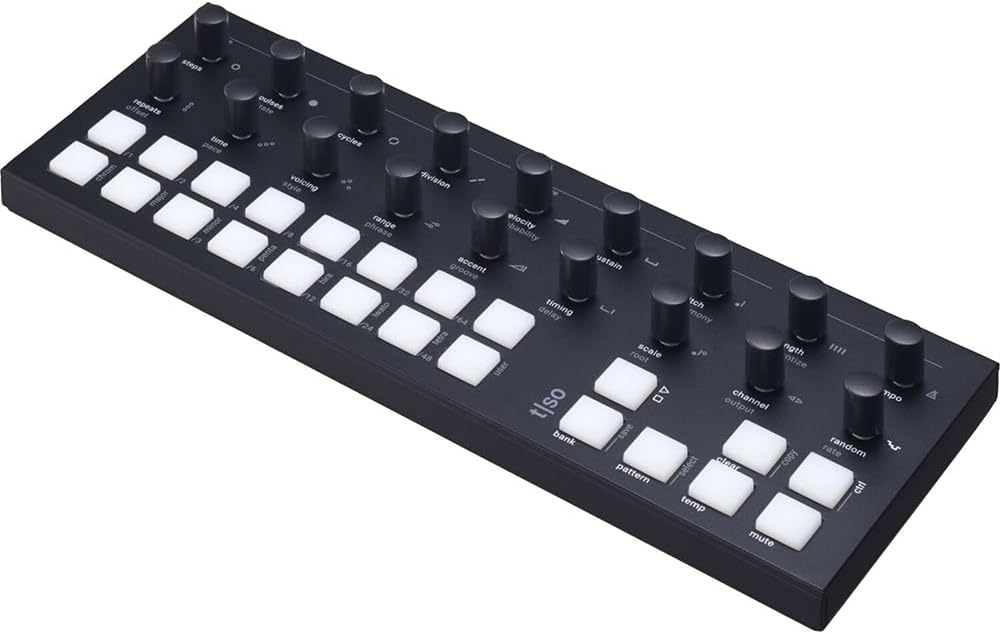
A hardware sequencer is the device that decides when your drum sounds play. Think of it as a conductor: rather than playing every hit by hand in real time, you program or generate patterns ahead of time and the sequencer fires those sounds in order, on cue. When your drum rig grows beyond a single self-contained drum machine into multiple sound sources—separate synthesizer modules, a vintage drum box, a Eurorack rack—you quickly discover that each device wants to know “what should I play, and when?” A dedicated sequencer answers that question for all of them simultaneously. If you’ve been getting by with the built-in sequencer inside a Roland TR-8S or an Arturia DrumBrute Impact and are starting to feel its limits, or if you’re assembling your first modular percussion system and need something to drive it, this guide is built for you. We’ll map the three main sequencer paradigms—step sequencing, algorithmic sequencing, and CV/gate sequencing (explained below)—against real hardware options at real prices, and give you a clear decision rule at the end.
Step Sequencers: The Grid Is Still King
Step sequencing is the oldest and most intuitive approach: you place notes (or drum hits) on a fixed grid of steps, usually 16 to 64 slots long, and the machine plays them in order at a chosen tempo. Press a button on step 1 and step 5, and you get a kick on the 1 and the “and” of 2. It’s immediate, visual, and deeply connected to how most people think about rhythm.
The reason step sequencers remain dominant in drum rigs isn’t nostalgia—it’s precision. When you need a 4-on-the-floor kick with a snare locked to the backbeat and a hi-hat grid running against a syncopated clap, the step grid lets you see all of that at once. That visual feedback is genuinely irreplaceable in a live context.
Where step sequencing lives today:
The Elektron Digitakt (street price approximately $799 as of mid-2026) is the benchmark sequencer/drum sampler combination that MusicRadar’s hardware drum machine roundup consistently cites as the value leader in its price range. Its “trig” system offers per-step probability, micro-timing nudge, and conditional triggers—meaning a step can be set to fire only every other loop, or only when another track has fired recently. Sound On Sound’s in-depth Elektron workflow coverage notes that this conditional trigger system alone pushes step sequencing far beyond what a traditional grid implies.
The Elektron Analog Rytm MKII (approximately $1,599) takes the same step engine deeper, adding per-track LFOs that modulate sound parameters from within the sequencer. That’s a meaningful architectural difference: the sequencer isn’t just triggering sounds, it’s sculpting them on every step. Sound On Sound’s Analog Rytm MKII review describes this as Elektron’s signature contribution to live performance drum sequencing.
For producers who don’t need Elektron’s per-step parameter locks, the Squarp Pyramid MK3 (approximately $599) offers a more neutral, multi-track step grid that works cleanly with external hardware over MIDI. Sweetwater’s sequencer buying guide calls out the Pyramid for its unusually deep polyrhythm support—each track can run its own step count independently, so your kick can run 16 steps while your hat pattern runs 12, creating evolving patterns without manual reprogramming.
Algorithmic Sequencers: Letting Math Write the Pattern
Algorithmic sequencing replaces (or supplements) the manual grid with mathematical rules that generate patterns. The most common algorithm in drum contexts is the Euclidean rhythm—a method, popularized in music technology circles after a 2004 paper by computer scientist Godfried Toussaint, that distributes a set number of hits as evenly as possible across a set number of steps. Tell the algorithm “put 3 hits in 16 steps” and it returns a pattern that sounds like a classic Afro-Cuban clave. Tell it “5 hits in 16” and you get something closer to a reggae skank. The math produces rhythms that feel composed rather than random.
CDM’s coverage of Euclidean and generative sequencing workflows notes that algorithmic approaches have moved from a modular niche into mainstream hardware, with manufacturers adding them as secondary modes rather than primary operating systems.
Hardware built around algorithmic generation:
The Polyend Play (approximately $699) is probably the clearest mainstream entry point for algorithmic drum sequencing outside of Eurorack. Its “generative” mode uses probability and fill rules to mutate patterns over time, while a direct pad interface lets you lock down sections you want to keep. Attack Magazine’s overview of generative percussion tools describes the Play as a genuinely accessible bridge between the “press a button and something interesting happens” school and disciplined structural composition.
In the Eurorack format (modular synthesizer panels that fit into a standardized rail system measured in “HP,” or horizontal pitch units), algorithmic sequencers become a dedicated voice category. The Noise Engineering Mimetic Digitalis is a 14HP quad-channel CV sequencer that generates evolving pitch and trigger patterns through a phase-based algorithm rather than a fixed grid. Perfect Circuit’s Eurorack sequencer overview notes that the Mimetic Digitalis has become a go-to for producers who want their drum voices to shift textures across a long performance without hands-on intervention. Pair it with something like the 4ms Spherical Wavetable Navigator for tonal percussion layers, and the sequencer becomes the creative engine rather than just a clock divider.
The Make Noise René MK2 takes a different algorithmic approach: a two-axis Cartesian sequencer that moves through a 4×4 grid of values based on independent X and Y clock inputs. The path through the grid isn’t pre-written—it’s determined by how you patch those clocks. CDM has covered René-style Cartesian sequencing as one of the genuinely unique contributions Eurorack has made to rhythm generation, producing phrase shapes that no step grid can replicate.
CV/Gate Sequencers: Voltage as the Common Language
CV stands for Control Voltage, and gate refers to a simple on/off signal. Together they are the native language of analog synthesizers and Eurorack modules. When you plug a gate output from a sequencer into a drum voice’s trigger input, you’re telling that voice: “fire now.” When you send CV, you’re saying “fire now and tune yourself to this voltage.” For modular drum rigs—where your kick might be a Moog DFAM, your snare a Make Noise Manis Iteritas, and your hats a pair of Noise Engineering Basimilus Iteritas Alter modules—a CV/gate sequencer is the only way to drive all of them in a coherent, synchronized system.
The distinction that matters for buyers: MIDI-only sequencers cannot drive Eurorack modules directly without a MIDI-to-CV converter. CV/gate sequencers speak the language natively.
By the numbers — sequencer format compatibility:
| Sequencer | MIDI Out | CV/Gate Out | USB | Approx. Price (2026) |
|---|---|---|---|---|
| Elektron Digitakt | ✓ | — | ✓ | $799 |
| Squarp Pyramid MK3 | ✓ | ✓ (4 CV) | ✓ | $599 |
| Noise Engineering Mimetic Digitalis (Eurorack) | — | ✓ (4 CV+Gate) | — | $299 |
| Intellijel Metropolix (Eurorack) | ✓ | ✓ (2 CV+Gate) | — | $449 |
The Intellijel Metropolix deserves a specific callout for drum rigs that mix Eurorack voices with external MIDI gear. It outputs two independent CV/gate tracks with flexible stage-based programming, while also sending MIDI—so you can sequence a Moog DFAM via CV while simultaneously triggering a Roland TR-8S over MIDI from the same device. Perfect Circuit’s Eurorack sequencer catalog notes the Metropolix is one of the few modules that genuinely spans both worlds without requiring a separate conversion module.
For purely analog rigs, the Moog DFAM (Drummer From Another Mother, approximately $679) is technically a self-contained semi-modular percussion synthesizer with a built-in 8-step sequencer—but its Adv/Clock input makes it trivially patchable into any CV/gate master sequencer. Attack Magazine’s modular drum rig feature describes the DFAM as the most approachable entry point into CV-driven percussion synthesis precisely because its sequencer works standalone before you’re ready to patch it into a larger system.
Hybrid and “Master Clock” Architectures
Most serious drum rigs eventually land on a hybrid architecture: one master sequencer that distributes clock and pattern triggers to everything else. The practical question is where the master lives.
If your rig is MIDI-centric (TR-8S, Digitakt, external synths), a MIDI-capable sequencer like the Squarp Pyramid or Elektron Digitakt as the master clock makes sense. Sweetwater’s hardware sequencer buying guide recommends establishing clock hierarchy early—before purchasing additional gear—because retrofitting it creates sync headaches.
If your rig is Eurorack-heavy, a dedicated clock module like the 4ms Shuffling Clock Multiplier or the Pamela’s New Workout (approximately $225) functions as the master tempo brain, distributing divided and multiplied clock signals to every module. CDM’s coverage of modular clock architecture describes Pamela’s New Workout as arguably the highest “decisions per dollar” module in the Eurorack ecosystem for percussion rigs specifically, because it handles clock division, swing, and polyrhythm distribution in a single 8HP panel.
Decision Rule: If X, Then Y
The sequencer market in mid-2026 is deep enough that there’s a right answer for every rig configuration. Here’s the decision matrix:
If you’re building around MIDI hardware (TR-8S, DrumBrute, external synths) and want deep per-step parameter control: → Elektron Digitakt is the clear choice. Its conditional triggers and parameter locks are unmatched at the price, and MusicRadar’s roundup consistently places it at the top of the MIDI drum sequencer category.
If you want algorithmic generation without going full Eurorack: → Polyend Play gives you generative mutation with enough manual control to stop the chaos when you need to. It’s the least intimidating on-ramp to algorithmic rhythm outside the modular world.
If your rig is Eurorack-primary and you need CV/gate with MIDI flexibility: → Intellijel Metropolix handles both without a converter module, and its stage-based sequencing logic suits complex percussion voices better than a pure grid.
If you’re building a modular-only rig around analog voices (DFAM, Manis Iteritas, Basimilus): → Start with Pamela’s New Workout as the clock brain, add Noise Engineering Mimetic Digitalis for evolving CV pattern generation, and let those two modules handle sequencing duties before committing to anything more complex.
If budget is the primary constraint (under $300): → The Squarp Pyramid MK3’s used market price has settled around $350–$400 on Reverb as of early 2026, making it accessible. Below that, the built-in sequencer of a DrumBrute Impact ($299 new) is genuinely capable for step-only workflows and adds Eurorack-compatible gate outputs—a fact that Perfect Circuit’s DrumBrute Impact listing specifically highlights as a value differentiator.
The sequencer you choose isn’t just a utility purchase—it defines the grammar of your drum rig. Choose the one that matches how you think about rhythm, not just the one with the most features on the spec sheet.