Roland’s drum machines have shaped the sound of recorded music more decisively than almost any other piece of gear ever manufactured. The TR-808 — released in 1980 and discontinued just two years later after disappointing sales — became the rhythmic backbone of hip-hop, house, techno, and pop. The TR-909 followed in 1983 and its kick drum pattern is still the defining sound of four-on-the-floor dance music four decades on. Today, Roland keeps the lineage alive through a range of modern hardware built on what the company calls ACB, or Analog Circuit Behavior — a proprietary digital modeling approach that recreates the electrical behavior of vintage analog circuits inside a chip. The upshot: these modern boxes don’t require you to track down fragile, expensive vintage hardware to access those sounds. This guide cuts through the model confusion, explains what ACB actually delivers versus what it doesn’t, and gives you a clear decision rule for matching the right TR box to your actual workflow and budget.
What ACB Actually Means — and Where Its Limits Are
Roland introduced ACB with its Aira product line in 2014. The technology models analog circuits at the component level, recreating how capacitors charge and discharge, how transistors clip, and how the subtle voltage drift of aging components contributes to the characteristic “looseness” of vintage drum sounds. This is categorically different from sample playback — ACB machines are not playing back recordings of a TR-808; they are continuously computing the behavior of its circuitry in real time.
Attack Magazine’s historical overview of the TR-808 notes that the original machine used a combination of bridge-type circuits for the snare, a tuned resonant filter for the bass drum, and analog noise sources for hats — none of which translate cleanly into straightforward sampling. ACB’s modeling approach is specifically designed to address this, capturing the dynamic, voltage-dependent character that makes those circuits sound alive under different tuning and decay settings.
That said, the community consensus — reflected consistently across aggregated reviews on MusicRadar and forum discussion threads that gear journalists frequently cite — is that ACB captures the family resemblance of vintage TR sounds very convincingly, but it does not produce a signal that is bit-for-bit identical to a hardware 808 or 909. For the vast majority of production contexts, this distinction is academically interesting and practically irrelevant. However, for producers working in scenes where vintage hardware carries specific social or sonic cache, or for engineers who are A/B-ing against original hardware, the nuance matters.
The practical takeaway: ACB is a serious, production-ready technology — not a marketing shorthand for “digital sample.” Treat the TR-8S and its siblings as genuine synthesis instruments, not sample libraries in a box.
The Current Roland TR Lineup at a Glance
Roland’s modern TR family spans from under $200 to just over $500. Here’s where the key models sit as of mid-2026:
By the numbers
| Model | Street Price (USD) | Voices | Sample Import | Individual Outputs |
|---|---|---|---|---|
| TR-6S | ~$299 | 6 | Yes | 1 (mix) |
| TR-8S | ~$499 | 8+FX | Yes | 8 individual |
| TR-707 (reissue) | ~$449 | 16 | No | 4 groups |
Prices sourced from Sweetwater and Perfect Circuit product pages, May 2026. Street prices fluctuate with promotions.
The TR-6S is Roland’s compact entry into the ACB lineup — six voices, sample import capability, a single stereo output, and a smaller form factor that fits comfortably in a laptop bag. MusicRadar’s review of the TR-6S describes it as “a genuinely credible performance drum machine that punches above its price,” while noting that the lack of individual outputs is a real constraint for studio work where you want to process the kick, snare, and hats on separate mixer channels or through separate outboard gear.
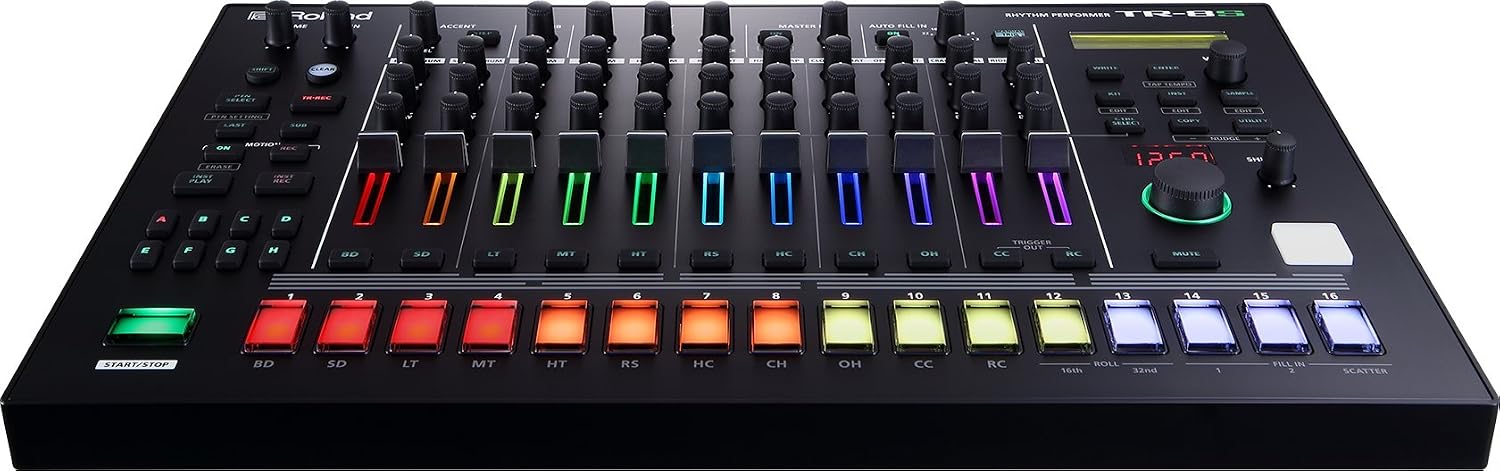
The TR-8S is the flagship modern TR. Sound On Sound’s review — one of the most detailed in-depth write-ups available on the machine — highlights its combination of ACB drum synthesis with the ability to import your own samples into each voice layer, eight individual outputs, motion sequencing (the ability to record knob movements as automation), and a build quality that owners consistently describe as stage-ready. At $499 street, it represents the clearest value proposition in the lineup for anyone who needs the box to work both in the studio and live.
The TR-707 reissue occupies a slightly different position — it’s a nostalgia play with contemporary I/O rather than a forward-looking production tool. Owners who already have deep TR-707 muscle memory or who are specifically chasing that mid-’80s electronic pop aesthetic report genuine satisfaction. For everyone else, the TR-8S is a more flexible investment.
Matching the Right TR Box to Your Actual Workflow
This is where the decision gets specific. The question isn’t which box is objectively “best” — it’s which box is right given your current rig, performance context, and where the gaps are.
If you’re building a first dedicated hardware rig and your budget tops out around $300: The TR-6S is the honest recommendation. The single output is a real limitation that you will feel eventually, but it can be worked around with a small mixer and some creative submixing. The sequencer is full-featured, ACB sounds are all present, and the sample import slot means you’re not permanently locked into the factory voice palette. Perfect Circuit’s ACB overview notes that all the core TR-808 and TR-909 voices are represented in the TR-6S, which covers the majority of what most producers actually need from a Roland drum machine.
If you’re building a stage rig and individual outputs matter: The TR-8S is the clear answer, and there’s not a close second in Roland’s current lineup at this price point. Eight individual outputs mean you can run your kick into a dedicated compressor, your snare into a reverb send, and your hats through a separate channel strip — the same signal routing architecture you’d expect from a full drum kit in a professional live context. Owners and live engineers consistently report that the TR-8S’s build quality holds up under touring conditions, and the scatter function and motion sequencing give you meaningful real-time performance tools beyond simple pattern playback.
If you’re a Eurorack or modular-adjacent producer who wants the TR sounds but wants CV integration: This is the genuine gap in Roland’s current lineup, and it’s worth naming plainly. The TR-8S has MIDI in and out, plus USB MIDI and audio, but it does not offer CV or gate outputs for direct modular integration without an intermediary interface. If your rig is built around Eurorack modules and you want the TR-808 kick voice available as a synthesis voice that responds to gate sequences from your modular, the community consensus points toward alternatives — specifically Eurorack modules that implement TR-style drum synthesis natively, such as several offerings from Noise Engineering, or toward using the TR-8S as a standalone island connected via MIDI rather than as an integrated voice in a modular system.
If you already own an original TR-808 or TR-909: The ACB machines are not replacements; they’re complements or alternatives for contexts where you don’t want to risk the vintage hardware. Owners who use both consistently report running the vintage box in the studio where it’s protected, and the TR-8S as the touring equivalent.
The Sample Import Question
One feature that distinguishes modern TR machines from their vintage predecessors is the ability to import your own audio samples and layer or replace the ACB voices with them. The TR-8S allows you to import WAV files via USB, assign them to any of its eight voice slots, and switch between ACB synthesis and sample playback — or layer both simultaneously.
This is genuinely useful, but the community’s pattern of use is instructive. Producers who primarily work with TR-808 and TR-909-adjacent sounds tend to leave the ACB voices alone and use the sample import as an overflow slot — for a specific clap sample, a longer percussion loop, or a custom sound they’ve designed elsewhere. Producers who need the TR as a more general-purpose drum machine — not exclusively locked to the Roland vintage palette — use sample import more aggressively, essentially turning the TR-8S into a hybrid synthesis-and-sample player.
Sound On Sound’s review explicitly notes that sample import doesn’t degrade the machine’s core identity; it adds a capability layer rather than replacing the synthesis architecture. The limitation is storage — you’re working within a fixed internal memory pool, not a streaming hard drive — but Sweetwater’s product specifications confirm that the available memory is sufficient for most performance and studio use cases without requiring constant file management.
The Vintage Hardware Question: Is an Original Worth Chasing?
As of mid-2026, functioning original TR-808s on the used market are trading in a range that makes them genuine collector items rather than practical production tools for most budgets. Reverb and aggregated used-gear pricing data consistently put clean, working 808s above $4,000 — with premium examples considerably higher — a price point that puts them in competition with a full Eurorack system or a flagship Elektron Analog Rytm MKII rather than against a $499 TR-8S.
The original TR-909 trades at lower but still significant premiums over modern alternatives. The practical argument for buying a vintage unit — beyond the investment angle, which is outside the scope of a production-tool buying guide — comes down to two things: the specific character of aging analog components that no modeling approach replicates exactly, and the workflow of using a physical object with decades of history. Neither of those is a trivial consideration. But for producers whose primary concern is making music rather than collecting hardware, the ACB machines close the gap to a point where the remaining difference is unlikely to meaningfully affect your recordings or performances.
Decision Rule Summary
The TR lineage is deep enough that there’s a genuine right answer for different readers — here it is, stated plainly:
- Budget under $300, first dedicated drum machine: TR-6S. Understand the output limitation going in; plan for a small mixer if studio work is on the roadmap.
- Budget around $499, needs individual outputs, plays live or works in a studio with a real mixer: TR-8S. This is the flagship recommendation for most readers at this tier, and reviewers across Sound On Sound, MusicRadar, and the broader production press consistently land here.
- Modular-first producer who wants TR voices in a Eurorack context: The TR-8S does not integrate natively via CV/gate. Budget for a MIDI-to-CV converter or look at Eurorack drum voice modules that implement analog percussion synthesis — Roland’s modern hardware line is not the right fit for this workflow without an intermediary.
- Vintage hardware at any price: The original TR-808 and TR-909 are valid tools with properties that ACB approximates but does not fully replicate. At 2026 market prices, treat them as investments with production upside rather than production tools with investment upside.
The TR lineage earns its reputation. The modern machines make it accessible without requiring you to take out a second mortgage on a piece of 1980s circuitry — and at $299 to $499, the ACB machines represent some of the most competitive value in hardware drum synthesis available today.