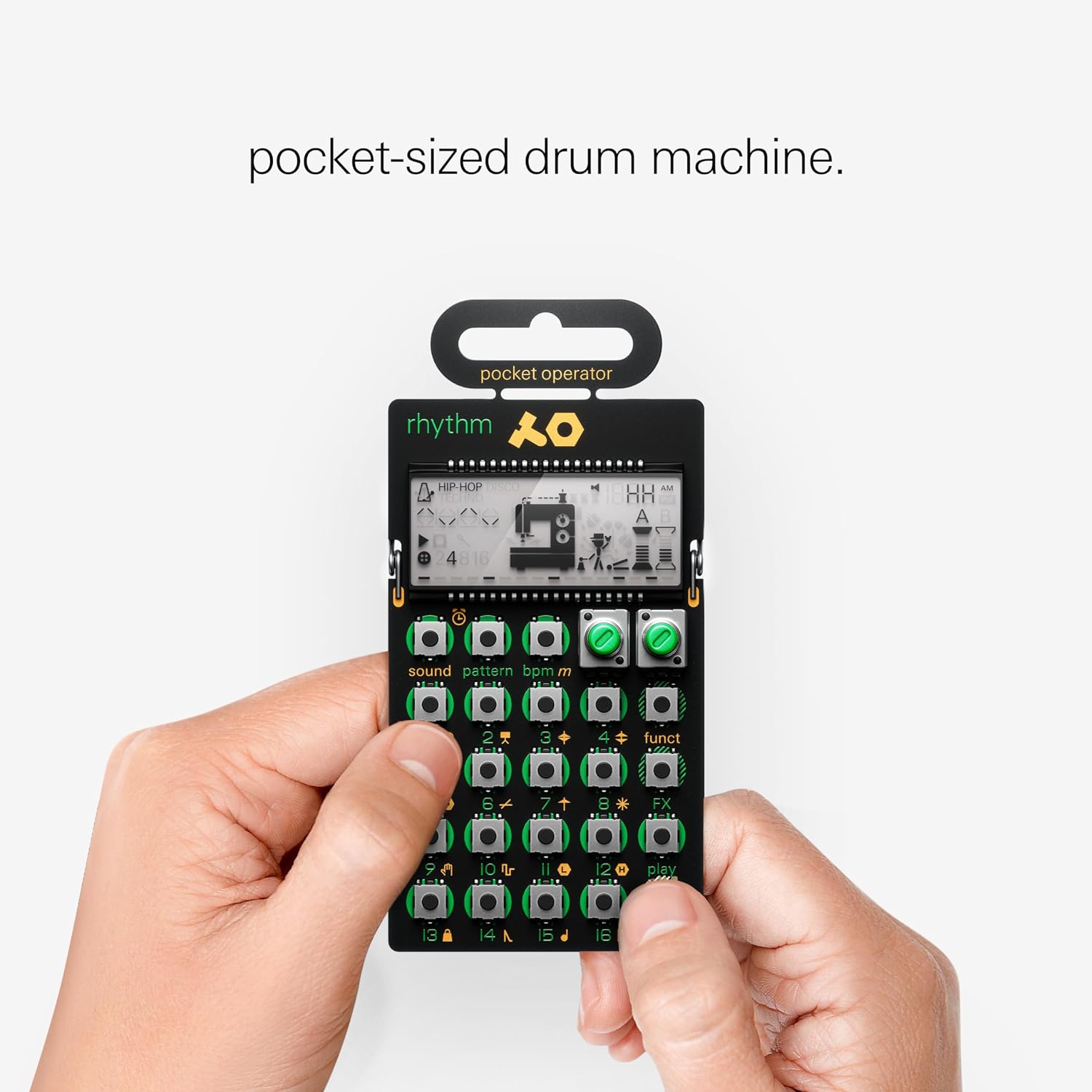
Teenage Engineering is a Swedish company that makes musical instruments and gadgets with a distinctive philosophy: pack maximum creative utility into the smallest, cheapest form possible, then make it look like something a museum would put under glass. Their Pocket Operators—a family of palm-sized synthesizers and drum machines that sell for $59–$99 each—and the more recent EP-133 K.O. II ($349) are the products that have earned the company a devoted following among electronic musicians at every skill level. If you’re new to hardware drum machines, think of a drum machine as a device that lets you program and trigger percussion sounds in real time, without needing a computer. Pocket Operators fit in a shirt pocket; the EP-133 is about the size of a paperback novel. Neither looks like traditional gear—no knobs, no wood panels, no blinking VU meters—but both are capable of serious rhythmic and synthesis work. This guide breaks down what each device actually offers, where the tradeoffs live, and which one fits which kind of workflow.
| EDITOR'S PICKteenage engineering EP–133 K.O.… | Mid-tierteenage engineering pocket oper… | Budget pickTeenage Engineering EP-1320 Med… | |
|---|---|---|---|
| Sampling | ✓ | ✗ | ✓ |
| Memory | 128MB | — | — |
| Built-in mic | ✓ | ✗ | ✓ |
| Effects | ✓ | Punch-in | ✓ |
| Parameter locks | — | ✓ | — |
| Price | $329.00 | $59.00 | |
| See on Amazon → | See on Amazon → | See on Amazon → |
What the Pocket Operator Line Actually Is (and Isn’t)
There are currently more than a dozen Pocket Operator models, each with a theme—beats, bass, arcade, robot—but for drum-focused producers, two stand out immediately: the PO-32 Tonic and the PO-33 K.O!
The PO-32 Tonic ($89) is a pure percussion synthesizer. It generates drum sounds algorithmically—meaning it uses mathematical models to recreate the behavior of membranes, metal, and noise rather than playing back recorded samples. This is what the broader electronic music community calls synthesis, and it’s the same underlying approach used by far more expensive machines like the Elektron Analog Rytm MKII. The PO-32 uses the Microtonic synthesis engine, designed by Swedish developer Magnus Lidström. Microtonic is widely respected in the sound design community; Attack Magazine’s coverage of Pocket Operator workflows notes that the PO-32 is the most technically ambitious device in the line precisely because of this synthesis core. You can design sounds directly on the unit using its 16-step parameter interface, and sounds can be transferred to and from the free Microtonic plugin via audio sync—a genuinely unusual feature at this price.
The PO-33 K.O! ($79) takes a different approach: it’s a sampler. You record audio directly into it through the built-in microphone or a 3.5mm input, then chop, pitch, reverse, and sequence those samples across 16 pads. It’s closer in spirit to a lo-fi SP-404 than to a synthesis engine—but its time-stretching, stutter, and slice-and-dice effects give it a chaotic, glitchy energy that reviewers at MusicRadar consistently describe as genuinely expressive rather than just gimmicky.
Both devices share the same hardware skeleton: a bare PCB (printed circuit board—the green board you’d normally find hidden inside electronics) with surface-mounted buttons, a small LCD display, a built-in speaker, and stereo 3.5mm in/out. They run on two AAA batteries. There is no screen for waveforms, no motorized fader, no dedicated MIDI port in the traditional sense. The tradeoff is stark: you get radical portability and a $79–$99 price tag, but you’re working within a menu-driven interface that requires memorizing button combinations. MusicRadar’s Pocket Operator buying guide is explicit that the learning curve is real—not because the concepts are hard, but because the interface gives you almost no visual feedback.
By the numbers — Pocket Operator quick specs:
| Model | Price | Core function | Sound storage | Sync |
|---|---|---|---|---|
| PO-32 Tonic | $89 | Drum synthesis (Microtonic engine) | 16 patches | Pulse/audio sync |
| PO-33 K.O! | $79 | Micro-sampler / beat slicer | ~40 sec audio | Pulse/audio sync |
| PO-12 Rhythm | $59 | Classic drum synthesis | Preset-based | Pulse sync |
The EP-133 K.O. II: Where the Line Gets Serious
In late 2023, Teenage Engineering released the EP-133 K.O. II, a $349 device that shares the K.O. name with the PO-33 but operates in a meaningfully different category. Sound On Sound’s review describes it as “a serious instrument that happens to look like a toy,” which is probably the most accurate single sentence written about it.
The EP-133 is a sampler—a device that records and plays back audio—with an integrated sequencer (a tool for arranging sounds into rhythmic patterns) and a surprisingly deep effects engine. It includes velocity-sensitive pads (the pads respond to how hard you hit them, like a piano key), a built-in microphone, stereo line input, and a punchy onboard compressor and overdrive that owners consistently report as a defining part of its sonic character. Synthtopia’s announcement coverage highlighted that the overdrive circuit in particular gives samples a warmth and dirt that reviewers compared favorably to far more expensive samplers.
Where the Pocket Operators feel like clever constraints, the EP-133 feels like a considered instrument. The workflow centers on four group tracks—A, B, C, D—each of which can hold multiple samples and run its own sequence. You can record audio in real time, immediately chop it into slices, assign those slices across the pads, and build a full beat in minutes. CDM’s hands-on coverage of the EP-133 noted that the slice-and-assign workflow is fast enough to use in a live performance context, which is a genuinely high bar for a sampler at this price point.
The sequencer offers 16-step programming with swing, probability, and conditional triggers—features that, until recently, were exclusive to the Elektron ecosystem at prices starting around $800. Conditional triggers let you tell a step to fire only on certain repetitions of a loop (for example, “play this hi-hat only every third time through”), which is one of the most powerful tools for making programmed beats feel human and non-repetitive.
There is, however, a real ceiling. The EP-133 is not a synthesis machine—it does not generate sounds from mathematical models the way a Roland TR-8S or the PO-32 Tonic does. Every sound starts as a recording. The effects—compression, overdrive, delay, reverb—shape those recordings aggressively, but if you want to sculpt the attack curve of a kick drum from raw oscillators, you need a different tool. Perfect Circuit’s editorial notes on the EP-133 are careful to position it as a “creative sampler and performance tool” rather than a synthesizer, and that distinction matters when you’re deciding where it fits in a rig.
Sync, Integration, and the Chain Problem
One question intermediate producers hit quickly with Teenage Engineering gear: how does it talk to the rest of your setup?
Pocket Operators use an audio-based pulse sync system—a steady click signal transmitted through the 3.5mm jack that tells downstream units when to advance their sequencer. This means you can chain multiple Pocket Operators together using a standard 3.5mm cable, or sync them to any device that outputs a steady pulse (including most DAWs, or digital audio workstations—software like Ableton Live or Logic Pro that runs on a computer). It is not MIDI (Musical Instrument Digital Interface—the decades-old communication standard that most professional gear uses), and it does not respond to MIDI clock natively. Attack Magazine’s workflow features on Pocket Operators explain that MIDI adapters exist—including Teenage Engineering’s own SY-1 sync cable—but adding them changes the price and portability equation.
The EP-133 is a step forward: it syncs via audio pulse the same way, but it also accepts MIDI over USB-C, which means you can connect it to a computer or a MIDI-capable hub and bring it into a larger setup without friction. Owners report that MIDI clock sync on the EP-133 is stable and responsive, making it a viable clock follower in a hybrid hardware/software rig. What it still lacks is traditional 5-pin DIN MIDI—the physical ports that older and some current hardware devices use—so if your chain depends on that standard, you’ll need a USB MIDI interface in the path.
For Eurorack modular users: neither Pocket Operators nor the EP-133 output CV (Control Voltage—the electrical signal format modular synthesizers use to communicate). The pulse sync signal is not CV-compatible without a dedicated converter module. This is a meaningful gap if you’re trying to integrate TE gear as a clock source in a modular system, though community-built solutions and modules from makers like 4ms do exist for bridging this.
Decision Framework: Which Device for Which Situation
The honest comparison across this line comes down to four variables: synthesis vs. sampling, performance vs. studio, budget ceiling, and integration depth.
If you’re building your first hardware percussion setup on a tight budget and you want to understand drum synthesis from first principles—how a kick drum’s pitch envelope works, what noise-filtered through a bandpass filter sounds like as a snare—the PO-32 Tonic is one of the most educational tools available at under $100. The Microtonic engine has genuine depth, and the audio-transfer workflow with the free plugin means you can go deep on sound design at the computer and push results to the hardware. MusicRadar’s buying guide consistently points to the PO-32 as the Pocket Operator with the highest ceiling for serious sound design work.
If you work primarily with samples—field recordings, chopped breaks, vocal hits—and you want a fast, performable hardware sampler that doesn’t require a laptop on stage, the EP-133 K.O. II is the clearest recommendation in this entire product family. At $349, it competes credibly with the Teenage Engineering OP-1 Field ($1,999) for pure beat-making workflow (not for breadth of features), and it undercuts the Roland SP-404 MK2 ($449) while offering a more immediate live performance interface, per aggregated reviewer consensus across Sound On Sound and CDM.
If your rig is already built around an Elektron Digitakt or Analog Rytm, the EP-133 is a compelling secondary performance piece—a portable sampler you can prep material on, take to a show, and use standalone without risking your main setup. Owners in long-run reviews note that this secondary-rig use case is where the EP-133’s battery operation and compact footprint become genuine advantages rather than compromises.
If you need deep CV integration or want synthesis that goes toe-to-toe with dedicated analog drum voices, neither Pocket Operators nor the EP-133 will fully satisfy. That’s not a failure of design; it’s a scope mismatch. The DFAM, Manis Iteritas, or a purpose-built Eurorack drum voice system exist for precisely that reason.
The decision rule, plainly stated: if the goal is maximum synthesis depth under $100, choose the PO-32 Tonic. If the goal is a fast, expressive, portable sampler with a real performance workflow under $400, choose the EP-133 K.O. II. Both devices punch well above their price in the right context—and both reveal their limits quickly in the wrong one. Knowing which context you’re in before you buy is the only research that actually matters.