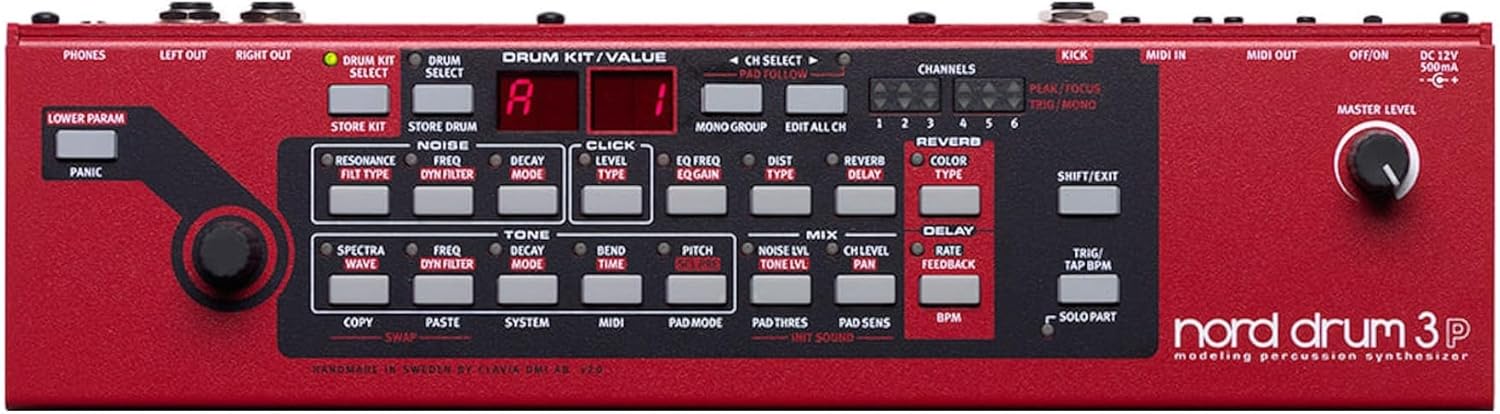
The phrase “drum synthesis” covers a lot of ground. At its simplest, it means generating percussion sounds electronically—rather than recording a real snare or kick drum—by shaping oscillators, noise, and filters in real time. Most drum machines you’ve encountered, from the Roland TR-808 to the Arturia DrumBrute Impact, do this with analog circuitry or digital samples. The Nord Drum 3P takes a different approach entirely: it uses physical modeling, a technique where a computer algorithm mathematically simulates the physics of a vibrating object—a drumhead under tension, a wooden shell, a stretched metal plate—to produce sound. That distinction sounds academic until you’re standing on a stage, and then it matters enormously. This article breaks down what physical modeling actually gives you in a live context, where it falls short compared to dedicated analog hardware, and how to decide whether the Nord Drum 3P deserves a place in your rig at its $899–$999 street price point in mid-2026.
What Physical Modeling Actually Means for Percussion
In an analog drum machine, a kick drum is typically built from a short burst of pitched oscillator swept rapidly downward, mixed with noise, and shaped by an envelope—a voltage-controlled circuit that determines how fast the sound attacks and decays. That circuit is fixed in its topology; you can modulate parameters, but you’re always working within the behavior of those physical components. Physical modeling flips this: instead of building a circuit that behaves like a drum, it solves equations that describe what a drum does acoustically—how the membrane resonates at different tensions, how the shell contributes overtones, how a mallet or stick imparts energy differently depending on velocity and contact point.
The Nord Drum 3P gives you six independent voices, each built around these modeling parameters: mesh type, mesh tension, mallet hardness, body resonance, and several others specific to tonal and noise-based components. Per Sweetwater’s specification notes, each voice can be driven from external trigger inputs, meaning you can connect acoustic drum triggers (piezo sensors) to pads or real drumheads and have the 3P respond dynamically to actual playing force—true velocity sensitivity that tracks like an acoustic instrument rather than a MIDI velocity lookup table.
Attack Magazine’s physical modeling synthesis explainer makes the key distinction clearly: because the synthesis engine is computing behavior rather than replaying a sample or running fixed circuitry, extreme parameter values produce sounds that couldn’t exist physically—drumheads with negative tension, materials with impossible density. This is where physical modeling earns its reputation as a creative tool beyond academic simulation.
The Live Performance Case: Where the 3P Has a Structural Advantage
For live performers, the comparison that matters most is the Nord Drum 3P against two categories of competitors: dedicated analog drum machines (Elektron Analog Rytm MKII, Moog DFAM, Buchla voice-based systems) and hybrid digital/analog machines (Elektron Digitakt, Roland TR-8S). Here are the tradeoffs laid out plainly.
Tuning stability under environmental conditions. Analog circuits drift with temperature. This is not a flaw—it’s physics—but it means analog drum machines, particularly Eurorack-based systems with multiple modules from different manufacturers, can sound noticeably different in a cold venue versus a warm one, or after 45 minutes of operation versus the first few seconds. Physical modeling runs on DSP (digital signal processing) hardware that is indifferent to ambient temperature. Sound On Sound’s Nord Drum 3P coverage notes this as a practical advantage specifically called out by performers who tour in varied climates.
Consistency across repeated takes. An analog envelope has tolerance variations; two nominally identical analog drum machines will sound subtly different. For studio composers, this can be desirable color. For a live performer trying to match a recorded track precisely at a festival, it is a variable they’d rather not manage. The 3P’s parameters are recall-perfect—save a preset, load it three months later, it is identical.
Pad triggering and acoustic integration. MusicRadar’s live electronic performance guides consistently identify the 3P’s pad triggering as one of its most distinctive features in this price tier. The ability to mount a standard acoustic drum trigger to a real snare, connect it to the 3P, and have the machine respond with a modeled sound that tracks velocity, cross-stick position (via zone mapping), and rimshot dynamics is genuinely uncommon at under $1,000. Competitors at this price typically offer fixed velocity curves from pad inputs, not the nuanced dynamic response the 3P provides when calibrated to a live kit.
By the numbers — Nord Drum 3P vs. key competitors at mid-2026 street price:
| Unit | Price (USD, approx.) | Voices | Analog Circuit | External Trigger Inputs | Preset Recall |
|---|---|---|---|---|---|
| Nord Drum 3P | $899–$999 | 6 | No (physical modeling) | 6 (per voice) | Yes, instant |
| Elektron Analog Rytm MKII | $1,699 | 8 + samples | Yes | Limited (2 inputs) | Yes, pattern-based |
| Moog DFAM | $799 | 1 (percussion path) | Yes | Patch-dependent | No |
| Roland TR-8S | $499 | 8 | Partial (ACB + samples) | 2 | Yes |
Sources: Sweetwater product pages, Perfect Circuit listings, manufacturer specification sheets as of May 2026.
Where Analog Still Wins: The Honest Tradeoffs
Physical modeling is not a universal upgrade. The community consensus, drawn from aggregated reviews at Sound On Sound and MusicRadar as well as long-run forum discussions across the synthesizer community, points to several areas where analog hardware maintains a genuine edge.
Harmonic character and “dirt.” Analog circuits introduce nonlinearities—subtle distortion, saturation, crosstalk between voices—that accumulate in ways that are difficult to model and that many producers describe as warmth or presence in a mix. The Elektron Analog Rytm MKII and the Moog DFAM, per their respective Sound On Sound feature reviews, produce a low-end density in kick and bass-drum sounds that physical modeling algorithms struggle to replicate convincingly. The 3P can produce excellent percussion, but owners and reviewers consistently note that its low-frequency punch is cleaner and more precise rather than organically weighted.
Hands-on circuit patching and CV integration. For Eurorack modular users, the 3P is largely outside the ecosystem. You can trigger it via gate signals (0–5V), and it has audio outputs, but there is no CV (control voltage) input for real-time parameter modulation of the modeling engine. A DFAM or a Noise Engineering Basimilus Iteritas Alter, by contrast, is entirely CV-addressable—every parameter responds to modular signals, enabling the rhythmic structures that define modular percussion synthesis as a discipline. Perfect Circuit’s editorial notes on the 3P explicitly acknowledge this limitation for modular-first users.
Sound design ceiling for extreme textures. Physical modeling parameters are organized around plausible physical objects, even when pushed to implausible values. The architecture still reflects where it started. Deep granular processing, the spectral behaviors of wavetable synthesis, or the feedback-based timbres of certain Eurorack modules are simply not what this engine does. If your percussion synthesis work trends toward industrial noise, microsound, or heavily processed abstract textures, the 3P is the wrong tool—not because it’s weak, but because it’s specialized.
Who Should Buy the Nord Drum 3P in 2026
The decision frame here is specific enough to be actionable.
Buy the Nord Drum 3P if:
- You are building or touring a live electronic kit that combines acoustic triggers with electronic sounds. This is the primary use case the instrument was designed for, and it’s where the dynamic response and recall stability compound into a meaningful workflow advantage.
- You need precise, repeatable sounds that match a produced track night after night without tuning drift or session-to-session variation.
- Your budget is under $1,000 and you want six fully independent voices with velocity-sensitive external triggering—no other single unit at this price delivers that combination.
- You are a studio composer who wants to notate and recall specific acoustic percussion models (tuned toms, ethnic percussion approximations, non-Western drum timbres) without building a sample library.
Do not buy the Nord Drum 3P if:
- Your primary context is Eurorack modular synthesis and you need CV-addressable percussion voices. Spend the budget on Noise Engineering modules, a Make Noise Manis Iteritas, or a Moog DFAM instead.
- You are chasing the specific harmonic weight and analog saturation of classic analog drum machines. An Elektron Analog Rytm MKII or even a used TR-909-era machine will serve that goal better; the 3P’s cleanliness is a feature, but it is not that feature.
- You are a producer whose workflow is DAW-first (digital audio workstation—software like Ableton Live or Logic Pro), and you have no live performance component. Plug-in physical modeling tools like Applied Acoustics Systems Chromaphone exist at lower cost and integrate more tightly into a software environment.
The Nord Drum 3P occupies a genuinely unusual position in the percussion synthesis market: it is not trying to replicate analog behavior, and it does not pretend to be a modular system. It is a precision performance instrument for a specific use case, and within that use case, per aggregated owner reports and long-run reviews at Sound On Sound and MusicRadar, it is arguably the most capable standalone unit available at its price in mid-2026.
The clearest decision rule: if you are performing live with acoustic triggers or need temperature-stable, recall-perfect percussion synthesis across six independent voices, the Nord Drum 3P is the correct purchase at this price tier. If your priorities are analog warmth, CV integration, or DAW-first workflow, redirect the budget accordingly—the alternatives named above are not compromises, they are simply different tools for different jobs.