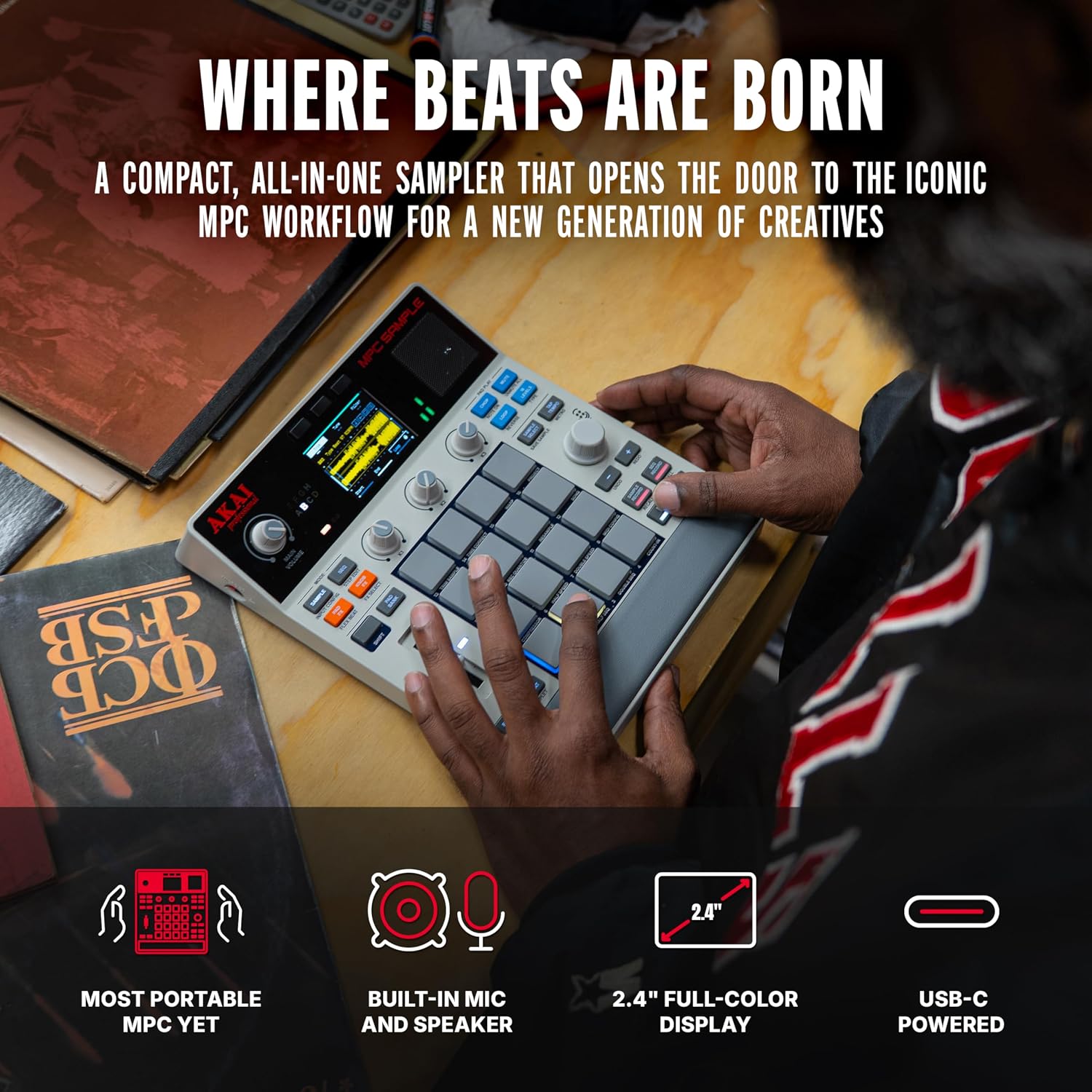
If you’ve been watching producer YouTube or scrolling gear forums lately, you’ve probably noticed four names coming up constantly in the same breath: the Akai MPC One+, the Novation Circuit Rhythm, the Roland SP-404MKII, and the Ableton Move. These are all grooveboxes or standalone samplers—self-contained hardware devices that let you record, chop, and sequence sounds without needing a laptop open in front of you. They’re designed to be the creative center of a beat-making session, not just a peripheral plugged into a computer. Each one has a passionate following, a distinct philosophy, and a price tag that asks you to make a real commitment. This article lays out what actually separates them—workflow, depth, portability, and value—so you can make a confident call instead of endlessly re-reading forum threads.
One quick note on naming: “sampler” means the device records and plays back audio clips you feed it; “groovebox” is a looser term for a device that combines sequencing (programming rhythmic patterns) with sound generation or sample playback in one box. All four devices qualify under the groovebox umbrella, but they lean differently—and that lean is the whole story.
By the Numbers: Price and Core Specs at a Glance
| Device | Street Price (May 2026) | Pads | Onboard Storage | Standalone? |
|---|---|---|---|---|
| Akai MPC One+ | ~$699 | 16 velocity-sensitive | 16 GB internal + SD | Yes (full OS) |
| Novation Circuit Rhythm | ~$349 | 32 RGB clip-launch | SD card only | Yes (limited) |
| Roland SP-404MKII | ~$499 | 16 + FX pads | 16 GB internal + SD | Yes |
| Ableton Move | ~$399 | 8×8 grid (64 pads) | 64 GB internal + SD | Partial (tethered for full power) |
Street prices sourced from Sweetwater and Perfect Circuit editorial listings, May 2026.
Workflow Philosophies: What Kind of Producer Are You Building For?
This is the question that matters more than any spec comparison, and it’s where reviewers consistently land when they’re being honest.
The MPC One+ is a full computer in a hardware shell. Akai’s MPC OS has been refined over a decade of iterative updates, and Sound On Sound’s review of the MPC One+ describes it as “the most complete standalone production environment available at this price point”—noting its support for VST plugins (when tethered), multi-track MIDI sequencing, and a workflow that maps closely to a DAW (Digital Audio Workstation, the software most producers use on a computer). That power comes with a learning curve. Owners consistently report that the first two to three weeks feel steep, especially if you’re coming from software. The menu depth is real. But once internalized, the MPC OS rewards that investment with capabilities none of the other three devices can match outright: time-stretching, pitch-shifting, track-level effects chains, and a 10-inch touchscreen that makes editing feel close to working in software.
The Novation Circuit Rhythm takes almost the opposite stance. MusicRadar’s Circuit Rhythm review calls it “the most immediately playable sampler in this price bracket”—and that’s by design. Novation stripped the concept down to 8 sample tracks, a simple 32-step sequencer, and a visual grid that tells you exactly where you are in the pattern at all times. There are no menus to navigate. You load samples via the Novation Components web app (browser-based, free), assign them to tracks, and start sequencing. Parameter locks—the ability to record a knob movement per step, not just per pattern—are present and approachable. What Circuit Rhythm gives up is depth: no sample editing onboard, no song arrangement mode worth naming, limited effects. For the producer who wants to sketch rhythmic ideas fast and has a separate mixing solution, that’s fine. For someone who wants the device to be the whole studio, it falls short.
The Roland SP-404MKII occupies a deliberately different creative space. Its reputation—documented extensively in MusicRadar’s SP-404MKII deep-dive—is rooted in performance and texture, not precision editing. The 404’s signature is its effects engine: vinyl simulation, scatter (a stutter-and-slice effect), sub-bass compression, and a “lofi” chain that ages audio in ways producers find genuinely musical rather than just gimmicky. Owners who use it live consistently report that the 404 rewards physical, gestural performance—hitting pads in real time, triggering effects manually, treating it more like an instrument than an editor. The workflow is pattern-based but also improvisational in a way that the MPC and Circuit Rhythm are not. Sweetwater’s buyer Q&A section for the SP-404MKII is full of producers asking whether it replaces their laptop; the honest consensus from long-run owners is no, but it makes a compelling argument for being your primary performance tool above everything else.
The Ableton Move is the newest entrant, and CDM’s first-look coverage frames it clearly: Move is designed as a hardware companion to Ableton Live (the software), not a truly standalone device. The 64-pad grid is immediately recognizable to anyone who has used an Ableton Push or a Launchpad. Move runs a version of Ableton’s engine natively, handles up to eight MIDI tracks, plays back clips, and—when tethered via USB to a computer running Live—integrates seamlessly with your full session. The “partial standalone” designation in the table above is important: Move can operate without a computer for basic playback and launching of pre-loaded clips, but the sound design depth and editing capabilities require Live running on a host machine. For Ableton-native producers who want a compact live performance controller that also sketches new ideas away from the desk, Move is arguably the most logical purchase on this list. For someone without a Live license or not embedded in that ecosystem, it’s the hardest to justify.
The Technical Tradeoffs You Need to Name Before Deciding
Sampling workflow depth: The MPC One+ leads by a significant margin. Time-stretch, chop, slice-to-MIDI—all present and functional onboard. The SP-404MKII has meaningful onboard resampling and a trim tool, but complex editing still favors pulling the card into a computer. Circuit Rhythm and Move offer the least onboard editing; both assume you’re prepping samples elsewhere.
Effects quality and character: The SP-404MKII is the community consensus winner here, and it’s not particularly close. Aggregated reviews across MusicRadar and long-run owner discussion consistently elevate its effects engine as a defining creative asset. The MPC’s effects are functional but clinical by comparison. Circuit Rhythm’s effects are minimal. Move leans on Ableton’s Simpler and Drum Rack engines, which are excellent in software but less distinctive in hardware-feel terms.
Portability and battery life: None of these devices includes a built-in battery. All four run on USB power or a dedicated adapter. The Move and Circuit Rhythm are the physically smallest and can run off a USB power bank in practice—something owners of both devices document in live-rig walkthroughs. The MPC One+ and SP-404MKII are desktop-class in size, though neither is heavy.
Connectivity: The MPC One+ has the most comprehensive I/O (Input/Output) suite: multiple MIDI ports, CV/Gate outputs for connecting to modular synthesizers, stereo inputs, and USB hub functionality. For producers building a larger rig, this matters. The SP-404MKII includes stereo inputs and MIDI I/O. Circuit Rhythm has MIDI I/O and stereo outputs but no audio inputs beyond its onboard sample recording via pad. Move is USB-first and designed around the Ableton ecosystem’s connectivity model.
Resale and used market behavior: As of May 2026, Reverb price data (cited in Perfect Circuit’s editorial market notes) shows the SP-404MKII holding resale value well—typically selling used in the $350–$420 range. MPC One+ units appear frequently in the $450–$550 band. Circuit Rhythm sits lower, around $220–$280 used, reflecting its more entry-level positioning. Move is still early in its used-market cycle, with limited data.
If X, Then Y: The Decision Rules
These are the honest “if this is you, buy that” conclusions that fall out of the research.
If your priority is maximum depth and you’re willing to invest in a learning curve, the MPC One+ is the clear choice. No other device in this group gives you a full production environment without a laptop. The $699 price is real money, but owners consistently report it displaces the need for a separate MIDI controller, audio interface for basic work, and drum machine. The math can work in its favor.
If you want to sketch ideas fast, you hate menus, and you have a DAW for finishing, the Novation Circuit Rhythm at ~$349 is the honest answer. It will never frustrate you with navigation. It will occasionally frustrate you with its ceiling.
If you perform live and want a device that rewards physical expression and has a genuinely distinctive sonic character, the SP-404MKII is where the community consensus lands. It’s the one device on this list that owners describe as irreplaceable rather than replaceable-by-software. That matters.
If you are already an Ableton Live user and want a hardware controller that also functions as a portable sketchpad within your existing setup, the Move is built for exactly you. If you’re not in the Ableton ecosystem, it’s the device on this list to skip.
One final note worth naming: these four devices are not really competing for the same producer. The forum arguments about which one “wins” tend to obscure the fact that they serve meaningfully different creative intentions. The producer who needs the MPC One+ would find the Circuit Rhythm limiting within a month. The producer who thrives on the SP-404MKII’s gestural workflow might find the MPC’s precision architecture creatively inhibiting. Reading the spec sheets without accounting for your actual working style is how you end up with a device that sits on a shelf. The better question isn’t which one is best—it’s which one maps to how you actually make music.