If you’ve spent any time shopping for a drum machine recently, you’ve probably run into terms like “hybrid engine,” “analog voice,” “digital synthesis,” and “plugin SDK” thrown around in product descriptions without much explanation. At the simplest level, a drum machine is a device that generates and sequences percussion sounds. But how it generates those sounds—the underlying technology, called a synthesis engine—determines almost everything about how it feels to use, how much you can shape the sounds, and whether it fits your budget and workflow. This article breaks down the three main categories of modern drum machine engines—pure digital, pure analog, and hybrid—and then zooms in on the most consequential examples in the current market: the Elektron lineup, the Korg drumlogue, and a handful of notable challengers. By the end, you’ll have a clear decision framework rather than a list of specs you have to decode on your own.
The Engine Taxonomy: Analog, Digital, and Hybrid—What Actually Differs
Before comparing specific boxes, it helps to be precise about what these categories mean in practice, because manufacturers use “hybrid” loosely enough that it can mean almost anything.
Pure analog engines generate sound entirely through electrical circuits—voltage-controlled oscillators (VCOs), filters, and amplifiers that process electrical signals without ever converting them to numbers. Classic examples include the Roland TR-909 and TR-808, whose kick and snare circuits are studied the way guitarists study vintage amp schematics. The sonic character—the way transients bloom, the way saturation creeps in at high levels—is a direct product of component behavior, not programming. The limitation is control: you can modulate what the circuit physically allows, and adding more voices means adding more circuitry and cost.
Pure digital engines represent sound as numbers and use DSP (digital signal processing) chips or CPUs to calculate waveforms in real time. The advantage is near-infinite flexibility: a digital engine can model a snare, a FM bass drum, or a granular texture with equal computational ease. The tradeoff, historically, has been feel—digital systems can sound sterile at low bit depths or sample rates, and latency in the digital-to-analog conversion chain can affect the tactile snap of a snare hit. Modern high-resolution digital engines have narrowed this gap considerably, but the debate persists in producer communities.
Hybrid engines combine both paths in the same instrument. The most common approach pairs analog circuits for the voice generation (VCO, filter, VCA) with digital control—meaning parameter storage, sequencer recall, and modulation routing are handled by a microprocessor, while the actual sound is still produced by analog components. A second hybrid model uses digital oscillators feeding analog filters: you get the harmonic richness of computed waveforms shaped by a real analog filter’s nonlinearities. A third, newer approach keeps everything digital but opens the engine to user-programmable plugins—essentially letting software developers extend the instrument’s synthesis vocabulary.
The Korg drumlogue exemplifies that third model, and it’s worth spending real time on it.
Elektron’s Approach: Per-Voice Flexibility in a Hybrid Architecture
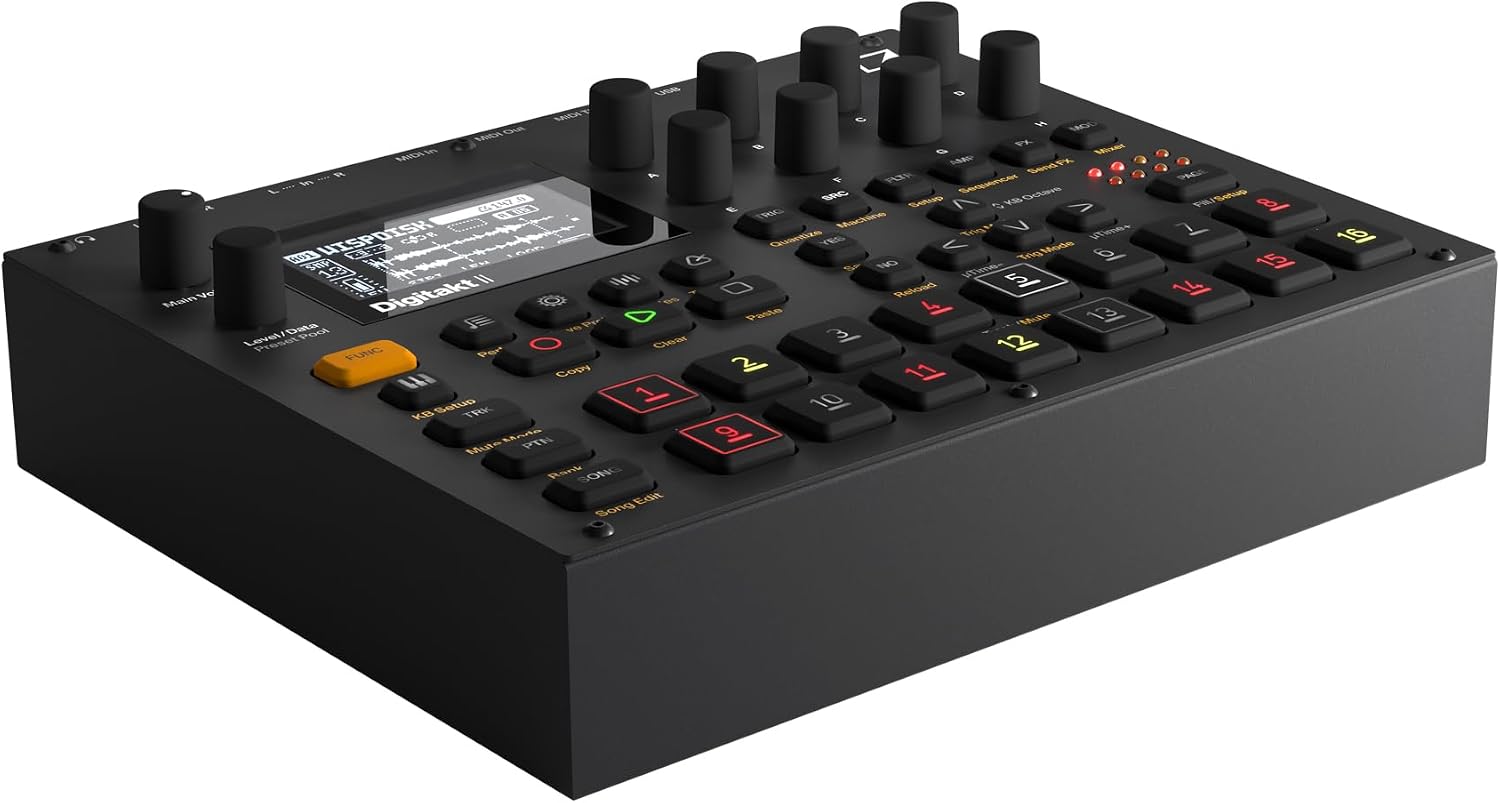
Elektron’s two flagship drum machines—the Analog Rytm MKII (street price approximately $1,499–$1,599 as of mid-2026) and the more affordable Digitakt II (around $899)—represent two philosophically distinct answers to the hybrid question.
The Analog Rytm MKII uses what Elektron calls a “true hybrid” design: each of its twelve voices combines an analog synthesis circuit with a digital sample layer. You can use just the analog engine (which covers standard synthesis archetypes—sine-based kicks, filtered noise snares, FM hi-hat variants), just the sample, or blend both simultaneously. The analog circuitry runs through individual analog overdrive and filter stages per voice, meaning each channel can be pushed into saturation independently. Attack Magazine’s Elektron workflow feature describes this architecture as particularly effective for producers who want the texture of analog saturation on a sample-based layer—a sound that’s difficult to replicate convincingly in software.
MusicRadar’s Analog Rytm MKII review highlights two community-consistent strengths: the per-track analog compressors (rare at any price), and the parameter lock system (Elektron’s term for recording per-step parameter automation, so each individual hit in a sequence can have its own filter cutoff, pitch, or envelope setting). The complexity ceiling here is high. The corresponding learning curve is also high—new Elektron owners consistently report two-to-four weeks before the sequencer’s conditional triggers and trig mutes feel intuitive.
The Digitakt II drops the analog voice circuits entirely and works from a digital sample engine with two oscillators per track and a multimode filter. CDM’s hybrid drum machine feature notes that Elektron’s decision to make the Digitakt fully digital while retaining their sequencing DNA (parameter locks, conditional triggers, probability) was a deliberate prioritization of workflow over analog purity—a tradeoff many producers gladly make at its lower price point.
By the numbers — Elektron flagship comparison:
| Analog Rytm MKII | Digitakt II | |
|---|---|---|
| Voice architecture | Hybrid (analog + sample) | Digital sample + synthesis |
| Voices / tracks | 12 analog + 8 sample | 8 sample tracks + 8 MIDI |
| Street price (mid-2026) | ~$1,499 | ~$899 |
| Per-voice analog filter | Yes | No (digital filter) |
Korg drumlogue: The Open-Engine Experiment
The Korg drumlogue (street price approximately $499–$549) represents something genuinely new in the dedicated drum machine market: a hybrid instrument whose digital engine is user-extensible through a published SDK (software development kit—a toolkit that lets programmers write new synthesis algorithms for the hardware).
The base instrument ships with six analog voices (kick, snare, three toms, and a utility voice) running through discrete analog circuits, plus four digital synthesis channels that Korg calls “digital parts.” Those digital parts are where the SDK comes in. Sound On Sound’s 2023 drumlogue review describes the SDK-derived plugin ecosystem as the instrument’s most forward-looking feature, noting that third-party developers had already released FM synthesis engines, physical modeling algorithms, and granular texture generators as free-to-install plugins within months of the hardware’s launch.
Perfect Circuit’s drumlogue coverage emphasizes the practical workflow implication: the drumlogue’s synthesis vocabulary isn’t fixed at the factory. If a new synthesis technique becomes desirable—say, a Karplus-Strong string resonator tuned for metallic percussion—a developer can implement it, and you can install it without a firmware update from Korg. The instrument evolves with the community rather than waiting for manufacturer release cycles.
The analog voice section is less complex than the Rytm’s—owners consistently report that the analog kick and snare are warm and punchy but offer fewer modulation targets than a dedicated analog drum synthesizer like the Moog DFAM. Sweetwater’s drumlogue product documentation lists the analog voices as having fixed-architecture circuits without per-voice overdrive stages, which is the primary sonic tradeoff versus instruments at higher price points.
For producers who want to experiment with synthesis architectures they didn’t anticipate needing at purchase time, the drumlogue’s open platform argument is compelling. For producers who know exactly what synthesis territory they’re working in and want the deepest analog implementation in that zone, the open SDK is a nice-to-have rather than a core value proposition.
The Wider Field: Where Roland, Arturia, and Eurorack Fit
The Roland TR-8S (around $499) positions itself as a pure digital instrument with “ACB”—Analog Circuit Behavior—modeling. Roland’s published description of ACB frames it as a digital emulation of the precise component behavior of TR-808 and TR-909 circuits, including the nonlinear saturation characteristics. Across aggregated reviews, the consensus is that ACB captures the macro behavior of those classic circuits convincingly, particularly for producers who are sequencing them into full mixes rather than processing them in isolation. The TR-8S also accepts samples and provides per-track effects—a flexible toolkit for live performance.
The Arturia DrumBrute Impact (around $299) is a fully analog instrument with no digital layer, making it the cleanest “pure analog” option in the entry-to-mid tier. The tradeoff is preset storage: traditional analog-only designs have limited ability to save and recall full patch states, which matters a great deal for live performers who need consistent setups across shows.
In the Eurorack modular world, the hybrid question takes a different form. Modules like the Noise Engineering Basimilus Iteritas Alter use digital FM synthesis optimized for percussive transients and don’t apologize for it. The Make Noise Manis Iteritas is a digital waveshaping engine designed specifically for industrial and noise-adjacent percussion textures. The Moog DFAM (Drummer From Another Mother) is fully analog, semi-modular, and deliberately minimal—eight steps, two oscillators, one filter. Perfect Circuit’s module documentation describes the DFAM as optimized for evolving, generative kick and bass drum sounds rather than multi-voice drum programming. These aren’t competitors to each other; they’re additive voices in a modular context where you’re assembling architecture voice by voice.
Decision Framework: If X, Then Y
Given where prices sit in mid-2026 and what the community has consistently reported about each architecture, here’s a clear-as-possible decision map:
If you want maximum analog depth on a budget and don’t need preset recall, the Arturia DrumBrute Impact at ~$299 is the cleanest path. You’re buying an instrument, not a production tool with deep parameter storage.
If you want a hybrid instrument with an evolving synthesis palette and you’re comfortable with a modest analog voice section, the Korg drumlogue at ~$499–$549 is the most forward-looking option in its tier. The SDK community is active and the open platform has real long-term value—you’re not locked into whatever synthesis architectures Korg chose at launch.
If Roland’s classic drum machine sounds are central to your work and you need sample integration, the TR-8S at ~$499 is the pragmatic choice. ACB modeling is convincing enough for most production contexts, and the workflow is accessible.
If you’re at the point where per-voice analog saturation, deep per-step modulation, and studio-grade per-track compression matter to your process, the Elektron Analog Rytm MKII at ~$1,499 is the instrument most consistently described by advanced users as career-length hardware—worth the learning curve investment because the ceiling is high enough that you’re unlikely to outgrow it.
If you’re building a modular Eurorack percussion voice and want to decide between analog and digital modules: base the choice on the specific synthesis character you need, not on analog/digital ideology. The Noise Engineering and Make Noise digital modules produce textures that analog circuits can’t replicate, and the Moog DFAM produces analog behavior that digital modeling approximates but doesn’t fully capture. They’re complementary architectures, not competing claims.
The engine architecture debate will continue as long as new drum machines ship. But the underlying question—what kind of sound shaping do I actually need, and what workflow supports how I create—has always been the one worth answering first.