If you’ve ever listened to a classic drum machine recording and thought, that snare has a specific personality I can’t quite name — you’re already tracking the core idea of this article. “Analog” drum machines generate their sounds using electrical circuits (resistors, capacitors, transistors) rather than playing back pre-recorded audio files. The result is a living, slightly imperfect sound that changes in small ways every time you hit it — and that organic variability is exactly what producers have chased for decades. But not all analog circuits are created equal. A Roland-inspired design from the 1980s has a completely different sonic fingerprint than a boutique Eurorack module built in a small workshop in 2024. This guide maps those differences across the main hardware categories available in mid-2026, names the tradeoffs explicitly, and gives you a clear decision framework for matching a machine’s sonic character to your actual musical goals.
Why Circuit Topology Is the Real Conversation
Most gear discussions get stuck on price tiers or brand loyalty. The more useful frame is circuit topology — the underlying electrical architecture that shapes how a drum sound is built and behaves.
Virtually every analog drum machine voice traces its heritage to one of a handful of foundational designs. Attack Magazine’s overview of analog drum synthesis identifies three dominant lineages: linear FM (frequency modulation using simple oscillators — the architecture behind Roland’s TR-808 and TR-909 bass drums), transistor-ladder or diode-ladder filter designs (associated with Moog’s characteristic warmth), and noise-through-filter approaches (the standard method for hi-hats and snares, used almost universally). Boutique and Eurorack designs often combine or distort these frameworks deliberately — stacking FM layers, adding wavefolder circuits, or routing voices through analog overdrive stages.
The practical implication: two machines both marketed as “analog” can sound radically different because one faithfully replicates a 1980 circuit and the other invents a new topology. Neither is inherently better, but they serve different music and different aesthetics.
The TR-Clone and TR-Inspired Camp: Grit With a Pedigree
The Roland TR-808 (released 1980) and TR-909 (1983) are arguably the most imitated circuits in the history of electronic music. Their distinctive sounds — the 808’s subsonic bass drum thud, the 909’s punchy kick and hissing open hi-hat — are so deeply embedded in hip-hop, house, techno, and pop production that “getting the 808 sound” is practically its own sub-genre of gear research.
The Roland TR-8S sits at the center of this conversation in 2026. MusicRadar’s TR-8S review notes that while the unit uses Roland’s ACB (Analog Circuit Behavior) digital modeling rather than literal analog circuitry, the sonic result is widely regarded by professional users as faithful enough that most listeners cannot distinguish it from original hardware on a mix. The TR-8S retails around $499 and adds a sample layer on top — a practical hybrid for producers who want the TR DNA with modern workflow flexibility.
For producers who want actual discrete analog components rather than modeled equivalents, the Arturia DrumBrute Impact ($299) represents the budget-analog entry point. Sound On Sound’s DrumBrute Impact review highlights its genuinely analog signal path and the “Distortion” per-channel circuit as a defining feature — owners consistently report that pushing that distortion yields a gritty, saturated texture that digital models struggle to replicate convincingly. The tradeoff: the DrumBrute Impact’s sonic palette is deliberately narrow. It leans hard into that aggressive, clicky, overdriven character. If you want clean or delicate, this is the wrong tool.
By the numbers — TR-inspired machines at a glance (mid-2026 street prices):
| Machine | Signal Path | Street Price | Defining Character |
|---|---|---|---|
| Roland TR-8S | ACB (digital model) | ~$499 | Faithful TR DNA, sample layer flexibility |
| Arturia DrumBrute Impact | True analog | ~$299 | Aggressive grit, per-channel distortion |
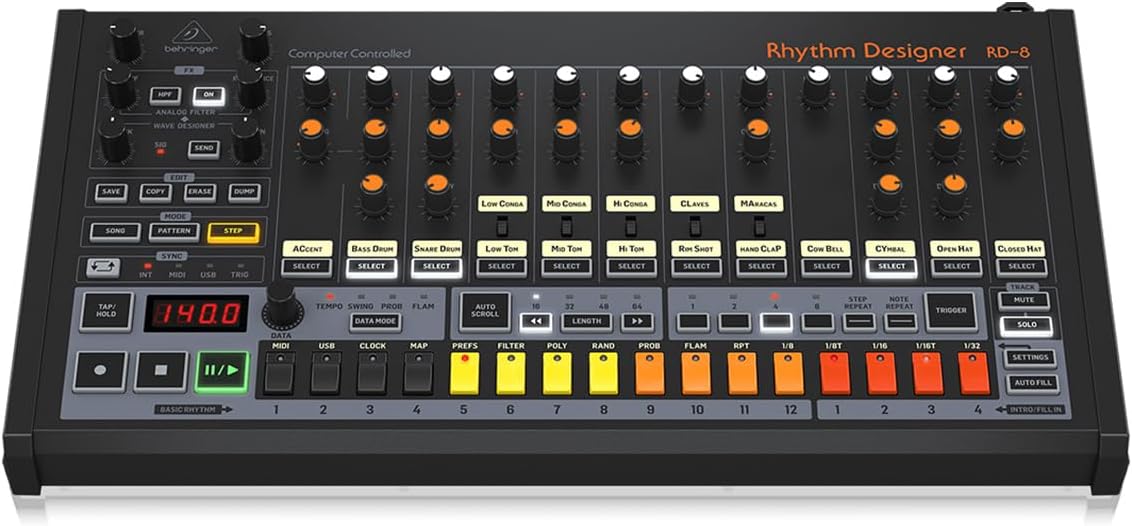
| Behringer RD-8 MKII | True analog clone | ~$199 | Faithful 808 architecture, utilitarian |
The Behringer RD-8 MKII deserves an honest mention at the $199 level. It is a circuit-level clone of the TR-808 and the closest you can get to original hardware without paying vintage prices (original 808s trade on Reverb in the $2,500–$4,000 range as of mid-2026, depending on condition). The community consensus is that it sounds genuinely good for the price, with the main compromises being build quality and some variability in unit-to-unit component tolerances — a real analog quirk that can go either direction.
Mid-Range and Flagship Analog: Where Character Gets Expensive
Once you move above $500, the market splits into two philosophies: integrated drum synthesizers designed to be complete performance instruments, and module-forward thinking where the drum machine is actually an assemblage of separate voices.
The Elektron Analog Rytm MKII ($1,499 street) is the reference point for the integrated category. CDM’s deep-dive on the Analog Rytm notes that each of its twelve voices combines an analog synthesis engine with a sample layer routed through the same analog filter and overdrive circuit — meaning samples are transformed by real analog hardware on their way out, not just played back digitally. Owners consistently describe the result as a “glue” quality: sounds feel like they belong together in physical space rather than sitting discretely in a sterile digital mix. The Rytm’s character is warm and slightly compressed even before you touch the compressor, which is either exactly what you want or subtly limiting depending on your genre.
The Moog DFAM (Drummer From Another Mother, ~$699) represents a deliberately different philosophy. Perfect Circuit’s editorial notes on the DFAM describe it as less a drum machine than a semi-modular (a synthesizer with some pre-wired connections but also exposed patch points for customization) percussion synthesizer optimized for experimental and industrial textures. Its two oscillators, sequencer, and Moog ladder filter produce sounds that can function as kick drums and tom-like voices but are engineered to go far beyond conventional drum timbres. Producers who want to make sounds that have never appeared in any sample library use the DFAM. Producers who need reliable, recognizable hi-hats probably shouldn’t lead with it.
Boutique and Eurorack Voices: Bespoke Warmth at a Premium
The Eurorack format — a modular synthesizer standard defined by a particular connector type (3.5mm “minijack”) and a 3U rack height — has become the home of the most adventurous analog drum circuit design. Modules here are individual voices: one module might be only a kick drum, another only a snare, and you assemble them into a system.
Noise Engineering’s oscillator-based voice modules, particularly the Manis Iteritas, have generated significant community discussion. Synthtopia’s overview notes that the Manis Iteritas uses a complex FM and wave-shaping architecture that produces percussion sounds with extraordinary harmonic density — owners describe it as sitting between a metallic industrial drum and a tonal bass voice, capable of both. At approximately $290 per module, the cost-per-voice math is sobering, but the design community consensus holds that there is simply no other way to get this specific character.
Make Noise’s Manis companion, the WMD Crater (a kick drum voice, approximately $219 per module), illustrates the boutique warmth end of the spectrum: a discrete analog bass drum design with voltage-controlled parameters that let the kick’s behavior respond to incoming CV (control voltage — signals from other modules that can modulate parameters in real time). Operators in long-run reviews note that the Crater’s character is fuller and more rounded than TR-derived circuits — less click-forward, more body-forward.
The honest tradeoff at this tier is system complexity and cost. A Eurorack percussion system capable of covering the standard kick/snare/hi-hat/percussion foundation, with a dedicated sequencer module to trigger it, can easily reach $2,000–$4,000 before you’ve added effects or a case. That’s not an argument against it — the sonic results are genuinely unique — but it’s a different decision than buying a self-contained machine.
Mapping Character to Genre: The Decision Framework
The pattern that emerges across community research, published reviews, and manufacturer design intent is fairly consistent. Here’s how to apply it:
If your music lives in house, techno, or hip-hop production and you need sounds that are immediately recognizable as part of the canon — the TR-808 kick, the snappy 909 snare — start with TR-DNA machines. The Roland TR-8S or Behringer RD-8 MKII gives you that lineage efficiently. The DrumBrute Impact works here too if your tracks lean distorted and aggressive.
If you’re producing electronic music where the drum machine is as much an instrument as a rhythm tool — where timbral evolution over a live set matters, where the kick should sound different in the breakdown than the drop — the Elektron Analog Rytm MKII’s combination of analog character and deep parameter control justifies its price for serious performers. CDM’s coverage consistently frames the Rytm as a composition environment, not just a beat box.
If you’re building a Eurorack system or have one already, adding dedicated percussion voices from Noise Engineering, WMD, or Make Noise produces sounds that cannot be obtained from integrated machines. The investment makes sense if modular is already your architecture. If you’re buying into Eurorack only for drums, the cost-to-result math is harder to defend versus the Rytm.
If sonic experimentation and industrial/noise/experimental percussion is the actual goal, the Moog DFAM is a nearly unique tool at its price point and a natural companion to any semi-modular system.
The underlying principle: analog character is a spectrum from “faithful circuit reproduction of a known sound” to “a new circuit that produces no familiar reference point.” Neither end of that spectrum is objectively superior. The decision is about which position serves your music and your workflow. Know where you’re trying to land, and the right machine becomes a much shorter list.